
 Round
Round Princess
 Pear
Pear Emerald
 Radiant
 Cushion
 Oval
Oval Heart
Heart Marquise
 Asscher
 Blue Sapphire
 Pink Sapphire
 Yellow Sapphire
 Garnet
 Tanzanite
 Emerald
 Amethyst
 Alexandrite
 Peridot
 Morganite
 Ruby
Ruby Aquamarine
 Blue Topaz
 Citrine
 Moissanite
South Sea Pearls Fast Facts
| Shape: | Round, semi-round, teardrop, and baroque |
| Size Range: | 9mm-20mm, with the average size around 12mm to 13mm |
| Colors: | Shades of white and golden yellow with overtones of blue, platinum, silver, rose |
| Rarity: | Rare, production limited. (The larger the pearl, the longer it had to cultivate in the oyster – adding to its rarity. |
| Origin: | Australia, Indonesia, The Philippines, Myanmar, Japan and Thailand |
| Mollusk: | Pinctada Maxima or Silver Lip Oyster |
| Grow Time: | 2-6 years (depending upon size desired) |
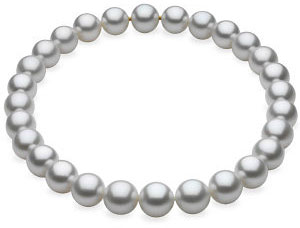
How to Grade South Sea Pearls
South Sea Pearls have the same grading system as Freshwater pearls which is as follows:

Nacre is between 2.0-4.0mm thick
The luster is considered sharp with a good rate of reflection
Reflected light sources have mostly crisp edges with slight blurring
Less than 10% on each pearl surface has some blemishes
Near-perfect matching is possible with little to no variation in color, tone, luster, shape or size

Nacre is between 2.0-4.0mm thick.
There is a fair amount of reflection with a mostly sharp luster
Reflected light sources have blurred edges
Less than 20% of the pearls surface may have slight blemishes
On an 18-inch strand, only 1-2 heavy blemishes are allowed
Very good matching; little variation in shape color, tone, luster, or size

Nacre measures between 2.0-4.0mm thick.
Pearls have a poor rate of reflection with a luster that is good to soft
Reflected light sources contain blurred edges
Less than 30% on each pearl surface show blemishes
One to two heavy blemishes are allowable on an 18-inch strand of Mabe pearls
Very good matching with little variation in color, luster, tone, size or shape

Low rate of reflection with a luster that is considered fair to soft
Reflected light sources are usually quite blurry
Less than 40% of the pearl’s surface is blemished
Deep inclusions should not make up more than 10-15% of the pearl’s surfaces with heavy blemishes visible
Fair to good matching with some variation in color, tone, luster, shape or size.


